
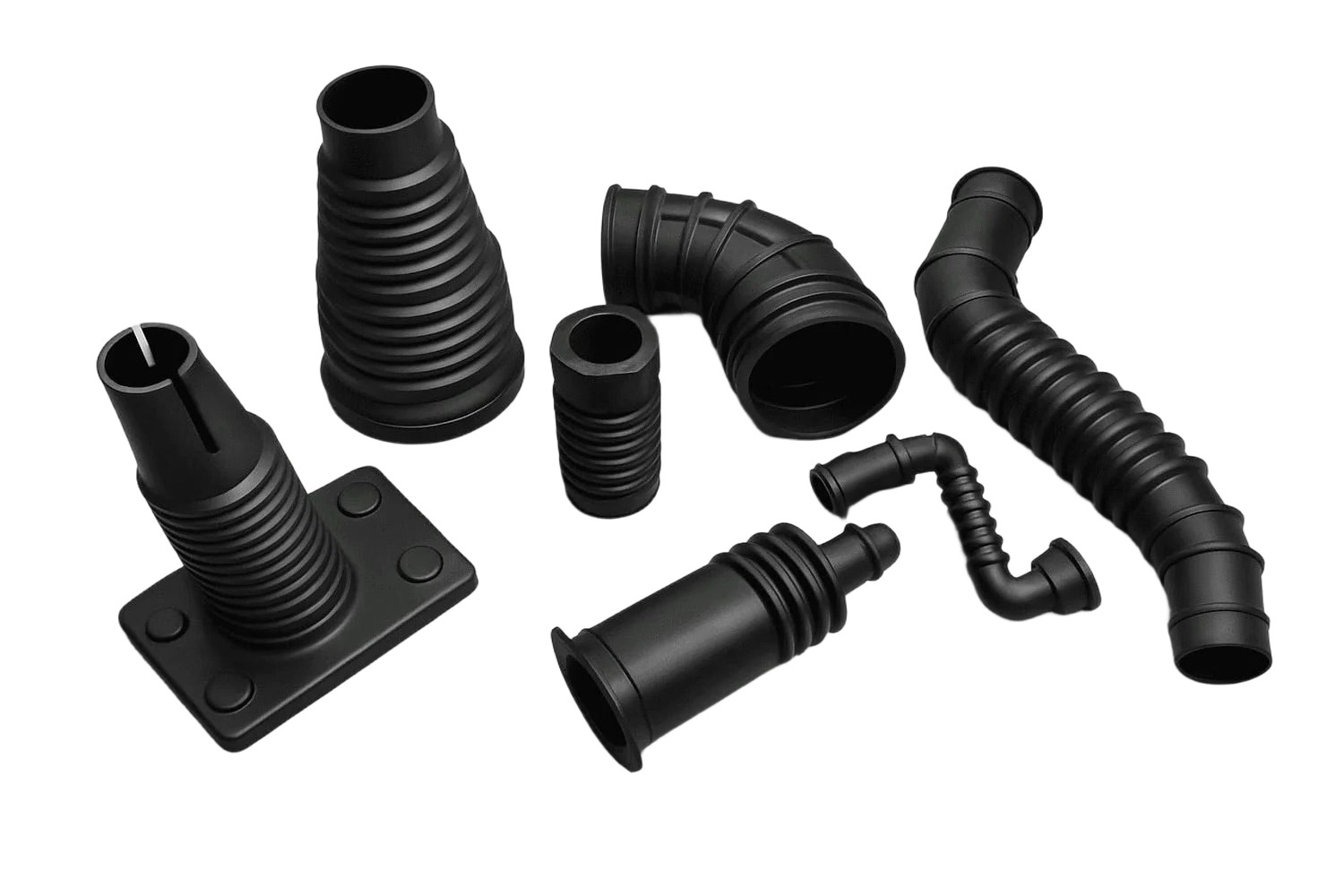
Automotive Rubber Bellows
Overview
Material Selection
-
EPDM (Ethylene Propylene Diene Monomer): EPDM is the workhorse elastomer for a wide range of OEM automotive rubber bellows applications, particularly those in the engine bay and chassis. Renowned for its exceptional resistance to ozone, UV radiation, and high temperatures (ranging from -40°F to 250°F, or -40°C to 121°C), EPDM also offers excellent resistance to water, coolant, and mild chemicals. Its superior flexibility, low compression set, and excellent weatherability make it ideal for bellows used in air intake systems, steering racks, suspension components, and heater core connections. EPDM is widely used in passenger cars and light-duty trucks, where components are exposed to consistent under-hood heat and environmental elements. Additionally, EPDM’s compatibility with modern coolant formulations (including ethylene glycol and propylene glycol) ensures that bellows used in cooling system applications maintain their integrity and performance over time, preventing coolant leakage and component damage.
-
Silicone Rubber: For high-temperature OEM applications, we utilize high-grade silicone rubber to manufacture automotive rubber bellows that can withstand extreme heat and maintain flexibility. Silicone rubber operates reliably in temperatures ranging from -60°F to 400°F (-51°C to 204°C), making it ideal for bellows used in exhaust systems, turbocharger connections, engine valve covers, and high-temperature electrical wiring harnesses. It also offers excellent electrical insulation properties, making it suitable for bellows used to protect sensitive electrical components in the engine bay, such as EV battery cooling system connections and high-voltage wiring. Silicone rubber is often used in premium OEM applications, including luxury vehicles, high-performance sports cars, and EVs/HEVs, where reliability in extreme temperature conditions is non-negotiable. Its resistance to thermal aging and chemical degradation ensures long service life even in the most demanding under-hood environments.
-
NBR (Nitrile Butadiene Rubber): Also known as Buna-N, NBR is used for automotive rubber bellows applications that require excellent resistance to petroleum-based fluids, oils, and greases. It operates effectively in temperatures ranging from -40°F to 212°F (-40°C to 100°C) and offers good mechanical strength and abrasion resistance. NBR bellows are commonly used in fuel system connections, transmission components, and oil lines, where they protect sensitive parts from oil contamination and mechanical movement. For high-performance OEM applications, such as racing vehicles or heavy-duty trucks, we use hydrogenated NBR (HNBR), which provides enhanced heat resistance (up to 300°F / 149°C) and improved durability, making it suitable for turbocharger oil line bellows and high-pressure fuel system protection.
Characteristics
Temperature Resistance: Automotive rubber bellows operate in extreme temperature ranges, from sub-zero winter conditions (-40°F / -40°C) to scorching under-hood temperatures exceeding 400°F (204°C) for high-temperature applications. Our bellows are engineered with material-specific temperature ratings tailored to their intended use, ensuring that they maintain flexibility, structural integrity, and seal performance across these extreme ranges. For example, EPDM bellows used in suspension systems are rated for -40°F to 250°F (-40°C to 121°C), while silicone and FKM bellows used in exhaust and turbocharger applications can withstand -60°F to 400°F (-51°C to 204°C). This temperature resistance prevents the bellows from cracking, hardening, or becoming brittle in extreme cold, or softening, deforming, or degrading in extreme heat—critical for OEM reliability, as temperature-related failures are a leading cause of warranty claims in the automotive industry.
Flexibility and Movement Compensation: One of the primary functions of automotive rubber bellows is to compensate for axial, lateral, and angular movements generated by vehicle operation—such as suspension articulation, steering movement, drive shaft rotation, and thermal expansion of components. Our bellows are designed with a precision-engineered corrugated structure that allows for maximum flexibility and movement, typically accommodating up to 20% of their length in axial movement, 15° of angular movement, and 10% of their diameter in lateral movement (depending on the application and design). This flexibility ensures that the bellows do not restrict the movement of critical components, while also absorbing stress and preventing damage to connected parts. The corrugated design also helps to dampen vibration, reducing noise transmission to the vehicle cabin and minimizing wear on sensitive components.
Chemical Resistance: Automotive rubber bellows are exposed to a wide range of harsh chemicals, including petroleum-based fluids (gasoline, diesel, engine oil, transmission fluid), coolant (ethylene glycol, propylene glycol), brake fluid, road salts, diesel exhaust fluids (DEF), and corrosive gases (from EGR systems). Our bellows are engineered with materials that offer superior resistance to these chemicals, preventing swelling, softening, hardening, or degradation that can lead to failure. For example, NBR and HNBR bellows resist petroleum-based fluids, EPDM bellows resist coolant and water, FKM bellows resist aggressive chemicals and DEF, and neoprene bellows resist road salts and mild chemicals. This chemical resistance ensures that the bellows maintain their performance and integrity over time, even when exposed to prolonged contact with harsh automotive fluids— a key requirement for OEMs seeking to minimize maintenance costs and maximize vehicle lifespan.
Abrasion and Wear Resistance: Bellows located in the undercarriage, chassis, and engine bay are exposed to significant abrasion from road debris (rocks, dirt, gravel), contact with other vehicle components, and road salts. Our OEM-grade rubber bellows are engineered to withstand this abrasion, featuring thick elastomer walls, reinforced construction (where applicable), and specialized outer coatings (CSM, polyurethane) to minimize wear and tear. For example, suspension bellows and CV joint bellows are manufactured with thicker neoprene or EPDM walls and abrasion-resistant coatings to protect against rocks and road debris, while under-hood bellows are designed with smooth outer surfaces to reduce friction with adjacent components. This abrasion resistance extends the service life of the bellows, reducing the need for premature replacement and lowering overall vehicle maintenance costs— a key benefit for both OEMs and vehicle owners.
Seal Integrity: A reliable, leak-proof seal is critical for automotive rubber bellows, as any gap or leakage can allow contaminants (dirt, moisture, chemicals) to enter and damage sensitive components. Our bellows are precision-molded to ensure tight, consistent seals with mating components—such as steering racks, drive shafts, and fittings. The elastomer materials are formulated to have excellent compression set resistance, meaning they maintain their shape and seal integrity even after years of constant pressure, movement, and thermal cycling. Additionally, our bellows are equipped with OEM-approved mounting collars, flanges, or lip seals that create a secure, leak-proof connection, preventing contaminants from entering and protecting the internal components. Every unit undergoes rigorous leak testing during manufacturing, with 100% of critical bellows (such as those used in brake systems and EV high-voltage applications) tested to ensure no leakage before leaving the factory.
Vibration Damping: Automotive systems generate significant vibration during operation, which can cause noise, wear, and premature failure of critical components. Our rubber bellows are engineered to dampen this vibration, acting as flexible buffers between moving parts and the vehicle’s chassis or body. The elastomer materials and corrugated design absorb vibration energy, reducing its transmission to other components and the vehicle cabin. This vibration damping not only improves ride comfort for passengers but also minimizes wear on connected parts—such as CV joints, steering racks, and electrical connectors—extending their service life and reducing warranty claims for OEMs. For heavy-duty commercial vehicles and high-performance applications, we offer specialized bellows with enhanced vibration-damping properties, ensuring optimal performance even in high-vibration environments.
 Applications
Steering System: The automotive steering system relies on rubber bellows to protect critical components and compensate for steering movement. Our steering system bellows are primarily used to protect steering racks, tie rod ends, and rack-and-pinion assemblies from dirt, moisture, and road salts. Manufactured from EPDM or neoprene (depending on the OEM’s requirements), these bellows are designed to accommodate the full range of steering movement—from full left to full right lock—without restricting performance or tearing. They also dampen vibration generated by the steering system, reducing noise and improving ride comfort. Our steering system bellows meet SAE J528 and OEM-specific standards, ensuring reliable performance and safety. For electric power steering (EPS) systems, we offer specialized bellows that protect the EPS motor and wiring connections, featuring enhanced electrical insulation and heat resistance.
Drivetrain and Transmission Applications: The drivetrain and transmission systems are critical to vehicle performance, and rubber bellows play a key role in protecting their moving components. Our drivetrain bellows include CV joint bellows, drive shaft bellows, and transmission output shaft bellows. CV joint bellows—manufactured from neoprene, HNBR, or FKM—protect the CV joints (which transfer power from the transmission to the wheels) from dirt, debris, and moisture, while also retaining the CV joint’s lubricating grease. These bellows are designed to accommodate the angular movement of the CV joints during suspension articulation and steering, ensuring long CV joint life. Drive shaft bellows, often reinforced with polyester or aramid fiber, protect drive shaft universal joints (U-joints) and slip yokes from contamination and dampen vibration, reducing noise and wear. Transmission output shaft bellows protect the transmission’s output shaft seal from dirt and moisture, preventing fluid leakage and transmission damage.
Suspension System: The suspension system is exposed to significant movement, vibration, and environmental contaminants, making rubber bellows essential for its reliability. Our suspension system bellows are used to protect ball joints, control arm bushings, shock absorbers, and strut assemblies. Manufactured from neoprene or EPDM, these bellows are designed with a thick, abrasion-resistant wall and a flexible corrugated structure to accommodate suspension articulation (up to 10 inches of travel in some heavy-duty applications) while shielding components from rocks, dirt, road salts, and moisture. They also absorb vibration and reduce noise, improving ride comfort and minimizing wear on suspension components. For heavy-duty commercial vehicles, we offer reinforced suspension bellows that can withstand the higher loads and harsher operating conditions associated with truck and bus applications.
Engine Bay: In the engine bay, automotive rubber bellows are used in a variety of applications, primarily to protect components from heat, moisture, and chemical exposure, while also compensating for thermal expansion and movement. Our engine bay bellows include air intake bellows, turbocharger bellows, EGR system bellows, and wiring harness bellows. Air intake bellows—manufactured from EPDM or silicone—connect the air filter housing to the throttle body or intake manifold, compensating for thermal expansion and engine movement while preventing unfiltered air from entering the engine. Turbocharger bellows, made from silicone or FKM, connect the turbocharger to the intercooler or intake manifold, withstanding extreme temperatures (up to 400°F / 204°C) and pressure while accommodating movement. EGR system bellows, made from FKM, protect EGR valves and pipes from corrosive exhaust gases, ensuring compliance with U.S. emissions regulations (EPA, CARB). Wiring harness bellows, made from EPDM or silicone, protect engine bay wiring from heat, moisture, and abrasion, preventing electrical failures.
Brake System Applications: Brake system safety is non-negotiable for U.S. automotive OEMs, and our rubber bellows are engineered to meet the strictest safety standards for brake system applications. Brake system bellows—manufactured from neoprene or EPDM—are used to protect brake line connections, master cylinder components, and caliper slide pins from dirt, moisture, and road salts. These bellows ensure that brake components remain free of corrosion and debris, maintaining consistent brake performance and preventing brake failure. They are designed to accommodate the movement of brake components during braking, while also resisting glycol-based brake fluids (DOT 3/4/5.1) and road chemicals. Our brake system bellows meet SAE J1401 and FMVSS 106 standards, ensuring full compliance with OEM safety requirements, and undergo 100% leak testing to ensure reliability.