
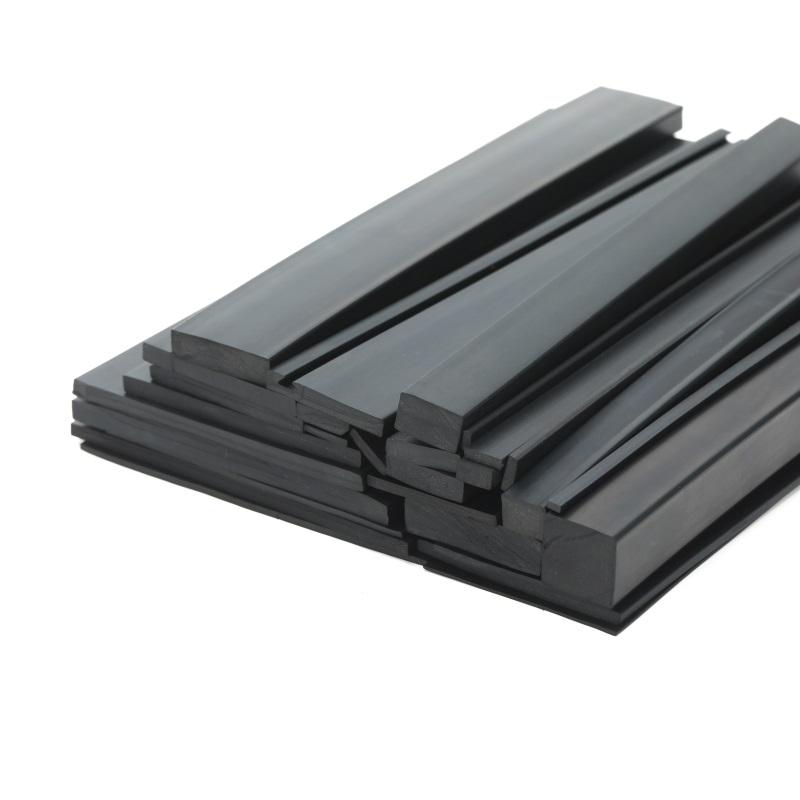
 EPDM Rubber Strips: The Versatile Sealing Solution for Demanding Environments
EPDM (Ethylene Propylene Diene Monomer) rubber strips have become indispensable across industries due to their exceptional durability and adaptability. Combining unique molecular properties with advanced manufacturing, these strips offer unmatched performance in sealing, insulation, and protection.
1. Material Composition & Manufacturing
EPDM is a synthetic rubber derived from ethylene, propylene, and diene monomers. Its saturated polymer backbone lacks reactive double bonds, making it inherently resistant to oxidation and degradation. Modern production uses microwave vulcanization, creating strips with seamless surfaces, uniform cell structures (in foamed variants), and consistent density. This process ensures precise dimensional stability and eliminates weak joints.
2. Key Features & Performance Advantages
- Extreme Temperature Resilience: Operates reliably from -45°C to +150°C without cracking, stiffening, or melting.
- Weather/Ozone Resistance: Withstands UV exposure, oxygen, and ozone (tested at 50 pphm for 72 hours), preventing premature aging.
- Waterproof & Low Absorption: Closed-cell foam structures absorb <5% water, ideal for outdoor or humid environments.
- Elastic Recovery: High compressibility (up to 50%) with near-perfect shape recovery after deformation.
- Chemical Safety: Non-toxic, halogen-free, and food-grade compliant options available.
3. Critical Applications
- Automotive: Door seals, trunk gaskets, window channels, and RV/boat fittings. Self-adhesive D-shaped strips simplify installation.
- Construction: Window/door weatherstripping, curtain wall joints, and expansion gap fillers. Prevents air/water infiltration in high-rises.
- Industrial: Electrical cabinet seals (fireproof/anti-dust), HVAC insulation, machinery vibration dampers, and conveyor covers.
- Infrastructure: Tunnel segment seals (e.g., shield tunneling), bridge expansion joints, and water treatment plants.
4. Competitive Advantages Over Alternatives
| Property | EPDM vs. PVC/Silicone/Natural Rubber |
|---|---|
| Lifespan | 10–15+ years (vs. PVC’s 5–8 years) |
| Cost Efficiency | Lower lifetime cost despite higher initial price |
| Eco-Profile | Recyclable, heavy-metal-free |
| Installation | Self-adhesive designs reduce labor/time |
5. Customization & Future Trends
Manufacturers offer tailoring in:
- Profiles: D-shaped, E-shaped, hollow tubes, bulb seals.
- Foam Density: From soft sponges to semi-rigid composites.
- Colors: Black, white, gray, and specialty hues.
Demand is rising in electric vehicles (battery sealants) and green buildings, driven by sustainability mandates.
Conclusion
EPDM rubber strips merge laboratory-engineered resilience with real-world versatility. As industries prioritize longevity and environmental compliance, EPDM’s role evolves from a simple sealant to a critical component in sustainable design. Ongoing innovations in foam technology and adhesion methods will further expand its applications in tomorrow’s engineered systems.