
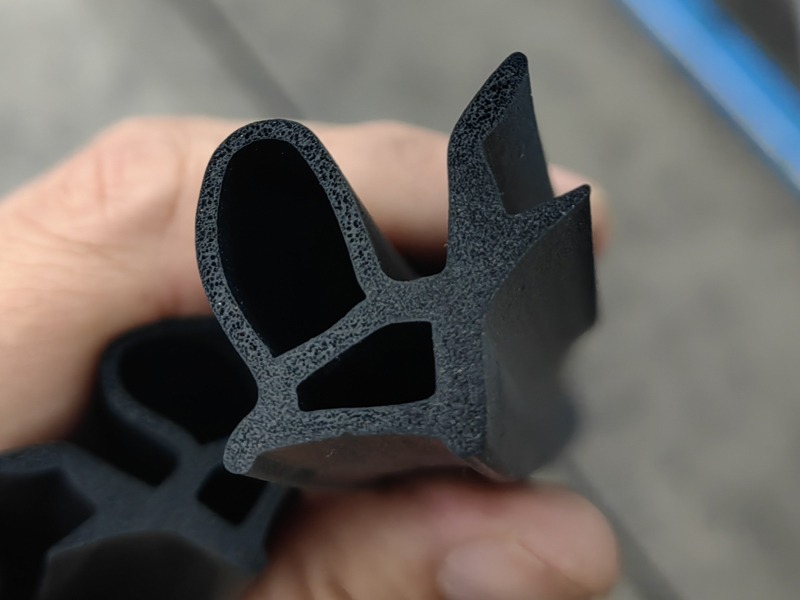
Achieving a 100% airtight and watertight seal requires materials that can compensate for manufacturing tolerances, thermal expansion, and uneven gaps. EPDM cellular rubber—commonly known as sponge rubber or expanded EPDM—is engineered specifically for this purpose. Combining a lightweight cellular structure with the legendary environmental resistance of EPDM, cellular rubber delivers unmatched sealing performance under low closure force.
Understanding Closed-Cell vs. Open-Cell EPDM Cellular Rubber
Cellular rubber is categorized based on its internal cellular morphology:
- Closed-Cell EPDM Rubber:Each microscopic gas cell is completely sealed off from adjacent cells by polymer walls. This makes closed-cell EPDM impermeable to air, water, and moisture, even when compressed. It is the premier choice for outdoor door seals and gaskets.
- Open-Cell EPDM Rubber:Cells are interconnected, allowing air and moisture to pass through unless compressed or treated with an outer skin. Used primarily for interior acoustic absorption and low-pressure cushioning.
Key Benefits of EPDM Cellular Rubber Door Seals
Engineers select cellular EPDM profiles for several distinct advantages:
- Low Closure Force:Soft and spongy texture allows doors and lids to latch easily without straining hinges or locking mechanisms.
- Excellent Gap Filling:Easily conforms to irregular contours, welding seams, and surface imperfections.
- Vibration Damping:Absorbs high-frequency mechanical vibrations, reducing rattles and noise in vehicles and appliances.
- Thermal Insulation:Air pockets within the cellular matrix enhance thermal break properties.
Primary Industrial Use Cases
EPDM cellular rubber features prominently in:
- Automotive Door & Window Weatherstrips:Secondary and tertiary door seals to block wind noise and water ingress.
- HVAC Equipment Enclosures:Access door gaskets preventing air leakage and energy loss.
- Electrical & Enclosure Cabinets:NEMA-rated outdoor cabinets requiring dust and moisture sealing.
- Appliance Gaskets:Refrigerator and washing machine door seals.
Design Considerations for Cellular Extrusions
When designing with EPDM cellular rubber, engineers must account for compression deflection curves, skin integrity (integral skin vs. cut edges), and adhesive backing selection for peel-and-stick mounting. Working with experienced extrusion manufacturers ensures optimal cell size distribution and compression set resistance.
EPDM cellular rubber combines softness, elasticity, and waterproof integrity, making it an indispensable material for modern sealing solutions. Whether for automotive weatherstripping or industrial enclosure gaskets, cellular EPDM ensures reliable, long-term performance.