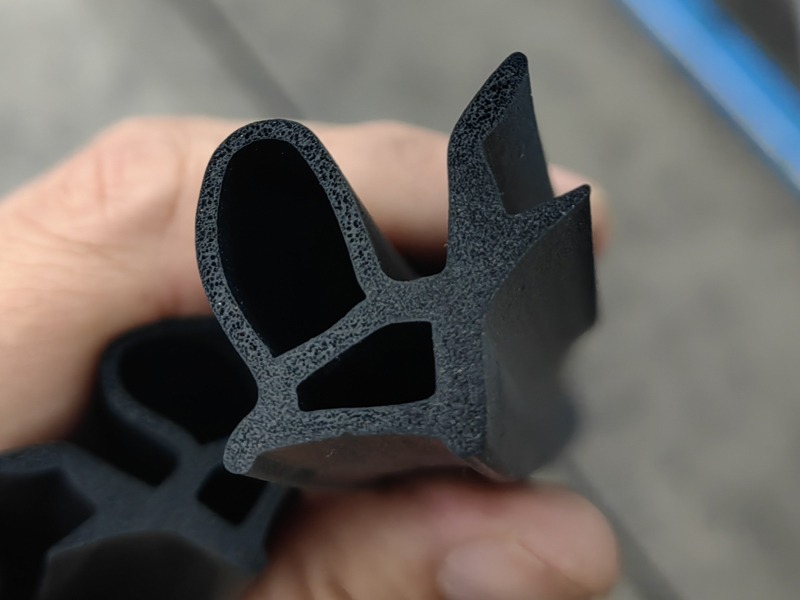
by admin admin No Comments

How Co-Extruded Edge Protection Sealing Profiles Cut Enclosure Assembly Time by 40%

On high-volume production lines for control cabinets and industrial housings, installing traditional glue-on gaskets is a major bottleneck. Surface degreasing, applying liquid adhesives, waiting for tack time, and cleaning up excess glue drive up labor costs. Co-extruded edge protection sealing profiles eliminate these steps entirely.

Key Production Line Benefits

  • Zero Surface Prep or Curing. Operators push the profile onto the sheet metal edge by hand or with a roller—no primers, solvents, or drying racks required.
  • Instant Handling & Shipping. Without wet adhesive curing, cabinets can be closed, inspected, and crated immediately after gasket installation.
  • Zero Rework from Misalignment. Push-on edge seals can be pulled back and repositioned cleanly in seconds without ruining the part.
  • Custom Pre-Cut Lengths. Ordering extruded rubber and plastic profiles pre-cut to exact cabinet perimeter lengths eliminates on-line measuring and scrap waste.

Value-Added Assembly Solutions from Hebei Shida Seal Group

To maximize your production line efficiency, Hebei Shida Seal Group offers full post-processing on all co-extruded edge protection sealing profiles, including precision length cutting, V-notching for effortless 90-degree corner bending, punching, and factory-applied 3M acrylic foam tape where flat-surface mounting is required.


Target Keywords: edge protection sealing profiles, extruded rubber and plastic profiles, control cabinets

by admin admin No Comments

Sourcing Custom Extruded Rubber Profiles Made in China

Global OEMs across North America and Europe increasingly rely on suppliers made in China for extruded rubber and plastic profiles and custom sealing gaskets. China’s mature polymer supply chain, advanced in-house tooling capabilities, and competitive manufacturing scale offer major cost and lead-time advantages—provided you vet your manufacturing partner carefully.

5-Point Supplier Verification Checklist

  • Quality Management Certifications. Verify active IATF 16949 and ISO 9001 certifications for strict process control.
  • Material Compliance Reports. Require RoHS, REACH, and UL94 test documentation backed by batch-level Certificate of Analysis (COA) sheets.
  • In-House Testing Lab. Confirm capability to test compression set, tensile strength, elongation at break, and ozone resistance on-site.
  • Pre-Production Sample Approval. Ensure the factory runs physical T1 extrusion samples for optical dimensional verification prior to mass production.
  • Export Packaging Standards. Verify moisture-barrier bagging and reinforced palletization to prevent profile deformation during ocean transit.

How Hebei Shida Seal Group Simplifies Sourcing from China

Located in Qinghe, Hebei—China’s premier rubber sealing manufacturing hub—Hebei Shida Seal Group eliminates the typical risks of overseas sourcing. Certified to IATF 16949:2016, ISO 14001, and ISO 45001, we operate in-house EDM wire-cut die design, automated rubber mixing, and a CNAS-aligned physical testing lab, providing transparent English engineering support and full PPAP documentation for global OEMs.

Target Keywords: suppliers made in China, extruded rubber and plastic profiles, sealing gaskets

by admin admin No Comments

Edge Protection Sealing Profiles: Preventing Wear & Ingress on Sheet Metal Enclosures

Stamped and laser-cut sheet metal panels are the backbone of modern machinery enclosures and electrical boxes, but raw metal edges create laceration hazards for technicians and easily slice through standard adhesive gaskets. Edge protection sealing profiles solve both challenges in a single component.

Dual-Purpose Engineering: Safety Meets Weatherproofing

Also known as bulb trim seals, edge protection sealing profiles combine a U-shaped gripping channel with a flexible tubular sealing bulb. When pushed onto the perimeter flange of a cabinet, the U-channel encases the sharp metal edge while the integrated bulb presses against the mating door to block water, dust, and noise.

Anatomy of a High-Performance Edge Seal

  • Internal Metal Carrier. High-grade edge trims feature an embedded segmented steel or aluminum core inside the U-channel, allowing the profile to bend cleanly around tight corners without kinking.
  • Internal Gripping Fins. Flexible rubber tongues inside the channel create friction against the panel, preventing the seal from slipping off during repeated door openings.
  • Top vs. Side Bulb Positioning. Top-bulb profiles seal vertically when a door closes onto the flange edge, while side-bulb profiles seal horizontally against an overlapping door face.

Supplier Advantage: Hebei Shida Seal Group

Hebei Shida Seal Group manufactures steel-wire and segmented-steel reinforced edge protection sealing profiles covering sheet metal thicknesses from 1.0 mm to 6.0 mm. Our self-clamping EPDM trims require zero glue, resist pull-off under heavy industrial vibration, and are available in continuous reels or notched, pre-cut frame lengths.


Target Keywords: edge protection sealing profiles, machinery enclosures, control cabinets

by admin admin No Comments

EPDM Solid vs. Foam Gaskets: Choosing the Right Seal for Control Cabinets

When specifying rubber seals for electrical panels and industrial housings, engineers almost always turn to EPDM. However, choosing between EPDM solid and foam (also known as sponge or cellular rubber) significantly impacts door closure force, environmental sealing, and mechanical durability.

What is Solid EPDM?

Solid EPDM is a dense, non-porous elastomer extruded into tough, high-tensile profiles (typically 40 to 85 Shore A). Because it has no internal air cells, it displaces rather than compresses easily, making it ideal for structural glazing channels, heavy load-bearing bumpers, and rigid mounting carriers.

What is EPDM Foam (Sponge)?

EPDM foam features a closed-cell internal structure filled with isolated gas pockets. When compressed, these cells flex easily, allowing the gasket to conform tightly to uneven surfaces and wide tolerance gaps while requiring minimal door-closing force.

The Hebei Shida Seal Group Dual-Durometer Advantage

Hebei Shida Seal Group specializes in co-extruding EPDM solid and foam into a single continuous profile. By fusing a dense 70±5 Shore A solid EPDM gripping base with a soft closed-cell EPDM sponge bulb (0.65±0.05 g/cm³), our dual-durometer gaskets eliminate the need for secondary adhesives while delivering low-force, watertight sealing for control cabinets.

Feature Solid EPDM Closed-Cell EPDM Foam
Hardness / Density 60 to 80 Shore A 0.65 g/cm³ (Medium)
Closure Force Required High Low to Moderate
Gap-Filling Ability Low (requires tight tolerances) High (compensates for uneven panels)
Tear & Abrasion Resistance Very High Moderate
Water & Dust Sealing Excellent under high clamp load Excellent with minimal clamp load

Target Keywords: EPDM solid and foam, control cabinets and equipment, sealing gaskets

by admin admin No Comments

Dual Durometer Combination Rubber Door Seals: Engineering Synergy


Sponge and Dense Dual Durometer Co-extrusion Rubber Seals

In many sealing applications, engineers face a conflicting design requirement: the part must grip firmly onto a metal flange or mounting channel (requiring rigidity and high tensile strength), while the sealing bulb must compress easily under light pressure to form an airtight barrier (requiring softness and flexibility). Traditional single-material designs often compromise one requirement for the other. The engineering solution? Combination rubber seals featuring both EPDM dense rubber and EPDM cellular rubber.

What is a Combination (Co-Extruded) Rubber Seal?

Combination seals are manufactured using advanced co-extrusion technology, where two or more distinct rubber compounds are fed through a single extrusion die simultaneously and cured into a monolithic part. Typically, the base or mounting clip section is made of hard EPDM dense rubber (often embedded with a steel wire carrier or metal insert), while the bulb or wiping lip is made of soft EPDM cellular rubber.

Advantages of Combining Dense and Cellular EPDM

This dual-duplex approach offers remarkable engineering benefits:

  • Secure Mechanical Retention:The dense rubber base resists pull-off forces, vibration loosening, and slip, ensuring the seal stays firmly in place.
  • Effortless Closing & Superior Seal:The cellular sponge bulb collapses smoothly under minimal pressure, creating a tight seal against water, dust, and wind noise.
  • Material Optimization:Puts each material exactly where its physical properties perform best, maximizing cost-efficiency and lifespan.
  • Integrated Features:Can incorporate flocking, slip coatings, or dual-duplex color matching in a single profile.

Common Applications across Industries

Combination rubber seals are widely utilized in:

  • Automotive Door Surrounds:Primary pinch-weld weatherstrips combining a dense grip with a sponge sealing bulb.
  • Bus, Truck, and Train Cab Doors:Heavy-duty commercial vehicle sealing.
  • Industrial Enclosures & Generator Canopies:Weatherproof access doors requiring robust attachment.
  • Marine Hatch Covers:Watertight closures subjected to dynamic wave action.

Custom Co-Extrusion Capabilities

Designing a custom combination profile requires expert tooling design and precise control over compound viscosities during co-extrusion. Manufacturers can tailor the shore hardness of the dense section and the expansion ratio of the cellular section to meet exact customer specifications.

Combination rubber seals represent the pinnacle of modern extrusion engineering. By uniting EPDM dense rubber and EPDM cellular rubber, these profiles deliver uncompromised mounting strength and peerless sealing performance.

by admin admin No Comments

EPDM Cellular Rubber: Sponge Profiles for Superior Sealing

Automotive DOOR-MOUNTED EPDM SPONGE SEALS PRIMARY (2)


Achieving a 100% airtight and watertight seal requires materials that can compensate for manufacturing tolerances, thermal expansion, and uneven gaps. EPDM cellular rubber—commonly known as sponge rubber or expanded EPDM—is engineered specifically for this purpose. Combining a lightweight cellular structure with the legendary environmental resistance of EPDM, cellular rubber delivers unmatched sealing performance under low closure force.

Understanding Closed-Cell vs. Open-Cell EPDM Cellular Rubber

Cellular rubber is categorized based on its internal cellular morphology:

  • Closed-Cell EPDM Rubber:Each microscopic gas cell is completely sealed off from adjacent cells by polymer walls. This makes closed-cell EPDM impermeable to air, water, and moisture, even when compressed. It is the premier choice for outdoor door seals and gaskets.
  • Open-Cell EPDM Rubber:Cells are interconnected, allowing air and moisture to pass through unless compressed or treated with an outer skin. Used primarily for interior acoustic absorption and low-pressure cushioning.

Key Benefits of EPDM Cellular Rubber Door Seals

Engineers select cellular EPDM profiles for several distinct advantages:

  • Low Closure Force:Soft and spongy texture allows doors and lids to latch easily without straining hinges or locking mechanisms.
  • Excellent Gap Filling:Easily conforms to irregular contours, welding seams, and surface imperfections.
  • Vibration Damping:Absorbs high-frequency mechanical vibrations, reducing rattles and noise in vehicles and appliances.
  • Thermal Insulation:Air pockets within the cellular matrix enhance thermal break properties.

Primary Industrial Use Cases

EPDM cellular rubber features prominently in:

  • Automotive Door & Window Weatherstrips:Secondary and tertiary door seals to block wind noise and water ingress.
  • HVAC Equipment Enclosures:Access door gaskets preventing air leakage and energy loss.
  • Electrical & Enclosure Cabinets:NEMA-rated outdoor cabinets requiring dust and moisture sealing.
  • Appliance Gaskets:Refrigerator and washing machine door seals.

Design Considerations for Cellular Extrusions

When designing with EPDM cellular rubber, engineers must account for compression deflection curves, skin integrity (integral skin vs. cut edges), and adhesive backing selection for peel-and-stick mounting. Working with experienced extrusion manufacturers ensures optimal cell size distribution and compression set resistance.

EPDM cellular rubber combines softness, elasticity, and waterproof integrity, making it an indispensable material for modern sealing solutions. Whether for automotive weatherstripping or industrial enclosure gaskets, cellular EPDM ensures reliable, long-term performance.


by admin admin No Comments

Rubber Parts for Food and Beverage Equipment: Questions to Ask

Rubber components used in food and beverage equipment may need to meet specific requirements for the intended application. A part’s material, design, and documentation should be considered together, and broad descriptions alone are not enough to establish compliance.

Identify the required standard

Before requesting a quote, determine which regulation, standard, or customer specification applies. Requirements can vary based on the equipment, food type, cleaning method, and where the part is used. Share the exact standard when known, rather than simply asking for “food-grade rubber.”

If you are unsure which requirement applies, describe the equipment and intended use so the relevant technical team can review it. Do not assume that a material suitable for one food-contact application is automatically suitable for another.

Describe cleaning and operating conditions

Food and beverage components may encounter cleaning agents, hot water, steam, temperature changes, and repeated wash cycles. Identify the cleaning products and procedures, along with operating temperatures and exposure durations.

The component’s function also matters. A gasket, seal, hose, or protective part may have different design requirements. Provide dimensions, assembly details, and expected movement or compression.

Request documentation and evaluate samples

Ask what documentation is available for the material and the specified application. Confirm that the information corresponds to the exact compound and requirement. A sample can help verify fit and function in the equipment, but compliance should be assessed against the applicable requirements—not appearance alone.

A clear specification helps suppliers evaluate materials and production needs. Identify the applicable standards, operating conditions, and part function early so potential compliance issues can be addressed before production.

by admin admin No Comments

Custom Rubber Gaskets: Getting the Fit and Function Right

A gasket may be a small component, but it can determine whether an assembly seals properly. A gasket that is too thin, too thick, poorly matched to the environment, or difficult to install can lead to leaks and unnecessary maintenance. Getting the specification right starts with understanding the assembly and the sealing task.

Explain what the gasket must seal

Describe what the gasket needs to contain or block: water, air, dust, oil, or another substance. State whether the joint is stationary or experiences movement, vibration, pressure, or repeated opening and closing.

The mating surfaces are just as important as the gasket itself. Include the dimensions of the groove or channel, the shape of the surfaces, and the available space. If the gasket is retained by adhesive, clips, compression, or another method, explain how it is installed.

Choose material for the actual environment

The material must be suitable for the conditions the gasket will encounter. EPDM is often considered for some outdoor and water-related uses. NBR is commonly evaluated for some oil-contact applications. These are broad guidelines, not universal answers. Temperature, chemicals, compression, and the specific compound all affect performance.

Share the actual fluids and chemicals involved rather than relying on general terms. Include temperature ranges, cleaning cycles, and exposure duration. If the application has required approvals or customer standards, provide those details early.

Provide a clear drawing or sample

A dimensioned drawing helps communicate the gasket’s shape and critical measurements. A sample can be useful when a drawing is unavailable or when the geometry is difficult to describe. If the part is used in an existing assembly, photos or assembly details can help explain how it fits and seals.

Identify critical dimensions and tolerances. Not every measurement needs to be controlled equally; prioritize those that affect compression, alignment, and retention. A review with your supplier can help determine what needs particular attention.

Test the gasket in service conditions

A sample should be checked in the actual assembly where possible. Confirm that it installs without damage, remains in position, and makes even contact. Test under representative pressure, temperature, fluid exposure, or movement conditions when relevant.

A successful custom gasket is more than a cut or molded shape. It is a component designed around the joint, material, assembly process, and environment. Clear information and practical testing help reduce the risk of leaks and premature failure.

by admin admin No Comments

What Is Edge Trim, and When Should You Use It?

A cut edge on a sheet-metal panel, plastic enclosure, or other component can create more than a cosmetic problem. It may be sharp, exposed to impact, or vulnerable to wear. Edge trim provides a protective covering for that edge and can also create a cleaner finished appearance.

Edge trim is commonly used on equipment panels, vehicle interiors, enclosures, machinery, and other products where people or components may contact a raw edge. Selecting the right trim depends on the edge itself, the surrounding environment, and how the finished assembly will be used.

How edge trim works

Many edge trims are flexible profiles that fit over the edge of a panel. Some use an internal gripping feature to stay in place, while others include an adhesive backing to support attachment. The trim’s shape and dimensions are designed for a particular range of panel thicknesses.

Once installed, edge trim can cover a sharp or unfinished edge, reduce direct contact with it, and help protect the edge from everyday wear. Some profiles also include a lip or additional feature to help cover a gap or improve the finished appearance.

Edge trim is different from a seal. A basic edge trim protects and covers an edge; it does not necessarily create a reliable barrier against water, air, or dust. If you need both edge protection and a sealing function, look at a trim-seal profile or another design specifically intended for that job.

Start with the panel thickness

Panel thickness is one of the first details to check. If the trim’s gripping channel is too narrow, it may be difficult to install or may not seat fully. If the channel is too wide, the trim may not hold securely.

Measure the panel at several points, especially if it has coatings, paint, or a non-uniform edge. Include any material that will remain beneath the trim. A small difference in finished thickness can affect fit.

The edge shape matters, too. A straight, consistent edge is generally easier to accommodate than a curved, irregular, or heavily contoured one. Check the inside and outside bend radii where the trim will follow corners. A profile that fits straight sections may wrinkle or pull away at a tight bend.

Choose the attachment method

Some edge trims rely on their profile to grip the panel. Others are available with adhesive backing, which may be useful when additional holding assistance is needed or when the application makes a gripping-only design less suitable.

The choice depends on the panel material, surface condition, and service environment. Adhesive performance can be affected by dust, oil, surface texture, temperature, and moisture. Prepare surfaces according to the adhesive requirements and test the installation on representative parts. Don’t assume that an adhesive will bond equally well to every paint, plastic, or coating.

Installation also affects retention. Determine whether the trim will be pushed on by hand or installed with a tool, and whether workers can access the full edge. A profile that is simple to install in a prototype may be more challenging on a large production assembly with tight corners or limited access.

Account for the service environment

Indoor and outdoor applications can place different demands on trim. Consider exposure to sunlight, ozone, temperature swings, water, cleaning agents, oils, and impact. The material needs to remain suitable for the conditions it will actually encounter.

If the trim will be exposed to heat or cold, check the expected temperature range and how the material behaves across it. If it may contact chemicals, identify the specific substances and confirm compatibility. “Industrial use” is not a complete material specification; two industrial environments can expose a part to very different conditions.

Appearance may also matter. Color, finish, and profile shape can contribute to the overall look of a product. For applications where trim is visible to customers, a neat, consistent fit may be just as important as edge coverage.

Know when a trim-seal profile may be better

If you need to protect an edge and help close a gap, an edge trim with an integrated sealing lip may be a better fit than a basic edge trim. A lip can contact an adjacent surface when a panel is installed, while the trim portion covers the edge.

This type of design needs careful evaluation. Check where the lip will make contact, how much it will deflect, and whether that contact stays consistent along the full edge. Consider panel movement and manufacturing tolerances; a seal that only touches in some locations may not perform as intended.

Test the fit in the real assembly

A sample lets you evaluate details that a drawing may not reveal. Install the trim on the actual panel and inspect the fit along straight sections, corners, and transitions. Check for gaps, looseness, visible damage, or places where the trim lifts away. If an adhesive is used, assess it after the relevant preparation and exposure conditions.

For repeat production, include installation instructions and establish a consistent process. Differences in panel thickness, cut quality, or installer technique can lead to variation from one assembly to the next.

We offer a range of edge trim products, including rubber edge trim, decorative edge trim, fire-retardant edge trim, and edge-trim options with additional features. The company also offers custom design capabilities and value-added operations such as cut-to-length services.

Before selecting a profile, record the panel thickness, edge shape, operating environment, appearance requirements, and preferred attachment method. With those details in hand, it’s easier to identify a practical option and test it before moving into production.

by admin admin No Comments

Solid, Sponge, and Dual-Durometer Rubber Seals: How to Compare Them

Solid, Sponge, and Dual-Durometer Rubber Seals: How to Compare Them

Choosing a rubber seal is not just a matter of picking a material. The seal’s structure and hardness affect how it compresses, how much force it needs to close, and how well it stands up to wear. Solid, sponge, and dual-durometer seals each suit different conditions.

Solid rubber seals

Solid rubber is dense and non-cellular. It is often selected when a seal must resist abrasion, tearing, or repeated loading while holding its shape. Depending on the rubber compound, it can also provide strong resistance to weather, water, oils, or chemicals.

The trade-off is that a solid seal may require more force to compress than a sponge seal. It can be a good fit for machinery, vehicle doors, protective edging, and other applications where durability and dimensional stability matter. A solid seal can still be soft or firm: its hardness depends on its durometer, not simply on being “solid.”

Sponge rubber seals

Sponge rubber contains cells that make it lighter and more compressible. It can conform to uneven surfaces and seal a gap with relatively little closing force, while also helping cushion impact and reduce vibration or noise.

Cell structure matters. Closed-cell sponge is generally better suited to blocking water and air; open-cell sponge allows air and moisture to pass through and is more appropriate where permeability is acceptable. Sponge seals can lose resilience if compressed too far, so the design should keep compression within the supplier’s recommended range.

Dual-durometer seals

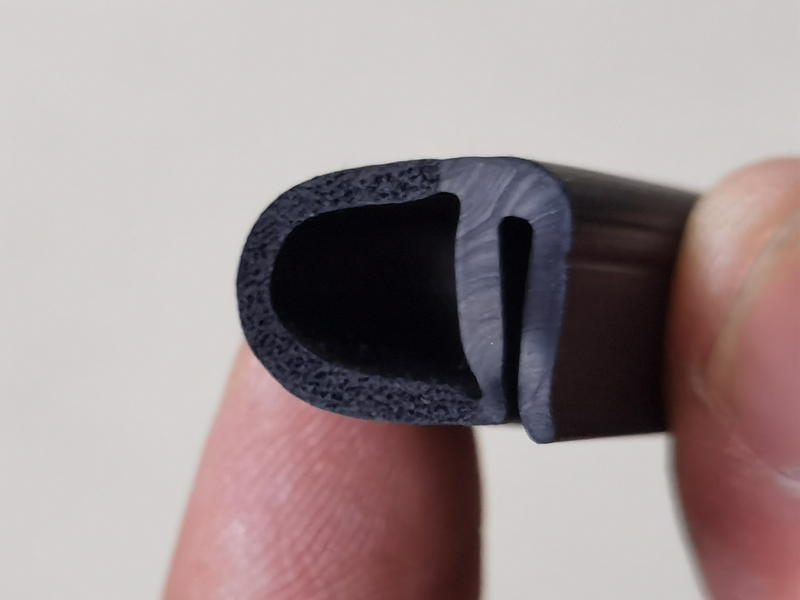
A dual-durometer seal combines two rubber sections of different hardness in one profile. For example, a softer section can flex against a mating surface while a firmer section supports the seal, attaches to a channel, or resists deformation. This can provide a balance that is difficult to achieve with one uniform hardness.

Dual-durometer construction is especially useful when a design needs both a compliant sealing lip and a stable mounting or support section. It is a profile configuration, rather than a guarantee of any particular performance: the compounds, geometry, bonding, and installation all affect the result.

Seal type Typical advantage Potential limitation Often considered for
Solid rubber Strength, wear resistance, shape stability May need greater closing force Heavy-duty gaskets, machinery, protective edges
Sponge rubber Easy compression, cushioning, gap conformity Can be damaged by excessive compression; cell type matters Enclosure doors, weather seals, vibration and noise control
Dual-durometer Combines a softer sealing area with firmer support More complex profile; design and bonding need validation Seals needing both flexibility and structural support

How to choose

Start with the application’s operating conditions, then compare candidate seal designs against these factors:

  1. Gap and tolerance: Measure the gap across the full perimeter, including variation from manufacturing and assembly.
  2. Closure force: Check whether the door, panel, or clamp can compress the seal reliably without excessive effort.
  3. Compression and recovery: Confirm the recommended working compression and whether the seal can rebound after repeated cycles.
  4. Exposure: Specify temperature, UV, water, oils, chemicals, dust, and cleaning agents. The rubber compound—not just whether it is solid or sponge—determines much of this resistance.
  5. Mechanical demands: Consider abrasion, impact, vibration, tearing, and any loads the seal must support.
  6. Cell structure and profile: For sponge, decide whether open- or closed-cell construction is appropriate. For dual-durometer, specify which section needs to be softer and what each section must do.

A practical starting point is sponge when low closing force and gap conformity are priorities, solid rubber when strength and wear resistance dominate, and dual-durometer when the seal needs both a compliant contact area and a firmer supporting section. Test a sample in the actual assembly whenever the seal is important to safety, weather protection, or equipment reliability.