
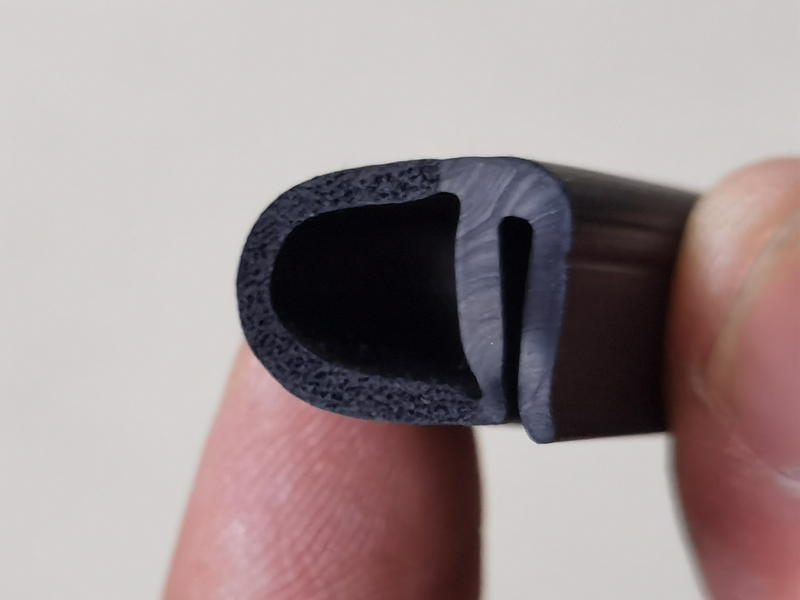
In many sealing applications, engineers face a conflicting design requirement: the part must grip firmly onto a metal flange or mounting channel (requiring rigidity and high tensile strength), while the sealing bulb must compress easily under light pressure to form an airtight barrier (requiring softness and flexibility). Traditional single-material designs often compromise one requirement for the other. The engineering solution? Combination rubber seals featuring both EPDM dense rubber and EPDM cellular rubber.
What is a Combination (Co-Extruded) Rubber Seal?
Combination seals are manufactured using advanced co-extrusion technology, where two or more distinct rubber compounds are fed through a single extrusion die simultaneously and cured into a monolithic part. Typically, the base or mounting clip section is made of hard EPDM dense rubber (often embedded with a steel wire carrier or metal insert), while the bulb or wiping lip is made of soft EPDM cellular rubber.
Advantages of Combining Dense and Cellular EPDM
This dual-duplex approach offers remarkable engineering benefits:
- Secure Mechanical Retention:The dense rubber base resists pull-off forces, vibration loosening, and slip, ensuring the seal stays firmly in place.
- Effortless Closing & Superior Seal:The cellular sponge bulb collapses smoothly under minimal pressure, creating a tight seal against water, dust, and wind noise.
- Material Optimization:Puts each material exactly where its physical properties perform best, maximizing cost-efficiency and lifespan.
- Integrated Features:Can incorporate flocking, slip coatings, or dual-duplex color matching in a single profile.
Common Applications across Industries
Combination rubber seals are widely utilized in:
- Automotive Door Surrounds:Primary pinch-weld weatherstrips combining a dense grip with a sponge sealing bulb.
- Bus, Truck, and Train Cab Doors:Heavy-duty commercial vehicle sealing.
- Industrial Enclosures & Generator Canopies:Weatherproof access doors requiring robust attachment.
- Marine Hatch Covers:Watertight closures subjected to dynamic wave action.
Custom Co-Extrusion Capabilities
Designing a custom combination profile requires expert tooling design and precise control over compound viscosities during co-extrusion. Manufacturers can tailor the shore hardness of the dense section and the expansion ratio of the cellular section to meet exact customer specifications.
Combination rubber seals represent the pinnacle of modern extrusion engineering. By uniting EPDM dense rubber and EPDM cellular rubber, these profiles deliver uncompromised mounting strength and peerless sealing performance.