

If you carefully observe designed objects around you, perhaps you may find the unspoken process of their birth. Their ingredients and parts should come from somewhere in this globe, and mixed and combined together in a factory of somewhere, through hands and ideas of somebodies.
Iran, France Sign MoU to Produce Car Rubber Parts in Iran
Iran and France signed a memorandum of understanding on Tuesday to produce automotive rubber parts in Iran in an agreement that is set to turn domestic producers into parts suppliers for French carmakers.
The agreement was signed by Mehdi Nekoumanesh, head of Iran Polymer and Petrochemical Institute (IPPI), and the president of Union des Syndicats des PME du Caoutchouc et de la Plasturgie (UCAPLAST), Denis Vaillant, Shana News reported.
UCAPLAST is an independent employers’ organization which represents all small and medium-size French enterprises in the rubber and plastics industry.
The MoU calls for sharing expertise of UCAPLAST member companies with Iranian manufacturers.
Affiliated to the Ministry of Science, IPPI oversees activities of 20 knowledge-based companies which produce rubber parts for automobiles.
The businesses are expected to sign an auto parts and supplies contract with the French automaker Citroen. The French company already has a joint production deal with Iran’s second-largest automaker SAIPA.
According to the deal, Citroen is required to export 30% of vehicles or auto parts manufactured under the JV through its international sales network.
The IPPI-UCAPLAST arrangement will enable local auto parts suppliers to make products that meet Citroen standards.
The MoU was signed on the sidelines of 11th International Exhibition of Plastics, Rubber, Machinery, and Equipment (Iran Plast 2017) held Sept. 24-27 in Tehran.
Easy Exports
For selling vehicles and components in the EU and countries under the United Nations Economic Commission for Europe Regulation 10, companies must have the E-mark certificates for their products.
However, according to the Head of the Bureau Veritas automotive department in Iran, Mehdi Parvini plastic automotive parts used in vehicles’ interior are exempted and do not need the certificates.
Obtaining E-mark certificates is an arduous and time-consuming exercise and seen as a hurdle to automotive exports from Iran. Therefore, it would be easier for Citroen and other French auto companies operating in Iran — namely Renault and Peugeot — to export plastic automotive parts produced in Iran through their international networks instead of exporting vehicles or engine parts.
Outdated technology used by Iran’s supply chain are seen as a hurdle in the way of expanding the local automotive industries and implementing local carmakers joint venture contracts with foreign firms.
Law stipulates that in all new agreements signed with foreign companies at least 40% of the vehicle parts should be manufactured in Iran. However, foreign carmakers are reluctant to comply for more reasons than one.
The IPPI-UCAPLAST deal should contribute to the implementation of the new JVs with foreign firms because plastic parts have an obvious share in the production of vehicles.
Pre-applied Butyl Sealant
Pre-applied Butyl Sealant
For better insulation properties, we can add / inject Butyl to trims, and seals such as door weatherstrips, trunk seals, trim seals, rubber edge trims, door sealings, edge protectors, edge protection sealing profiles can be provided with pre-applied butyl sealant at an additional cost to provide an improved grip and a positive seal with excellent heat reistance.
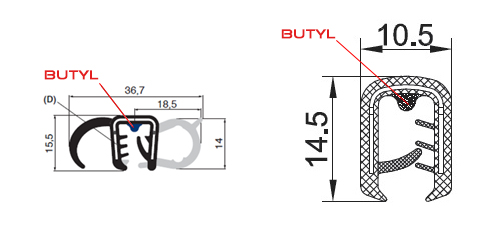
Keywords: rubber extrusions with injected butyl, rubber seals with butyl, rubber profiles with injected butyl, edge trims with butyl, butyl sealant, Butyl Injection, rubber edge trim with butyl adhesive
Cooper Standard opens new facility in Canada
SHERBROOKE, Quebec—Cooper Standard Automotive Inc. celebrated the grand opening of a new, 138,000-sq.-ft. site in Sherbrooke dedicated toward its Industrial Specialty Group.
The $10 million project consolidated three existing ISG facilities, bringing 250 employees under one roof. The site will produce extruded EPDM rubber sealing products for the non-automotive industrial, commercial and specialty vehicle markets. The site also will house a new enterprise resource planning system and provide employee skill enhancement programs.
North America President Bill Pumphrey said during a ribbon cutting ceremony on Sept. 21 that the $3.47 billion automotive supplier sees significant opportunities in the non-automotive sectors.
Sherbrooke Innopole worked closely with Cooper Standard during the completion of the project, which took two years.
ISH is a dedicated group within Cooper Standard that serves the power sports, marine, agriculture, construction, commercial vehicle and recreation vehicle markets.
Based in Novi, Mich., Cooper Standard is a leading automotive supplier with four core product focuses—rubber and plastic sealing, fuel and brake lines, fluid transfer hoses, and anti-vibration systems with 30,000 employees in 20 countries.
About Closed Cell Sponge Rubber
Closed cell sponge (or foam) is one of the two major categories of sponge material (the other category is open cell sponge). Closed cell sponge is a type of expanded rubber. Closed cell sponge is created when the bubbles produced during the manufacturing process are completely encompassed within the liquid raw material used to make the sponge. When the liquid sets, the gases are entirely encapsulated within each individual bubble, creating a solid yet lightweight structure.
Closed cell sponge is an extremely versatile material from which a variety of products can be fashioned. Because it is particularly good at keeping out moisture and water, closed cell sponge is very effective in applications where a watertight seal is required.
Closed-cell sponge does not have interconnected pores. As a result, closed cell sponge has a higher compressive strength than open cell sponge due to its structure. Closed cell sponge also possesses a higher dimensional stability, low moisture absorption coefficient, and higher strength compared to open cell sponge.
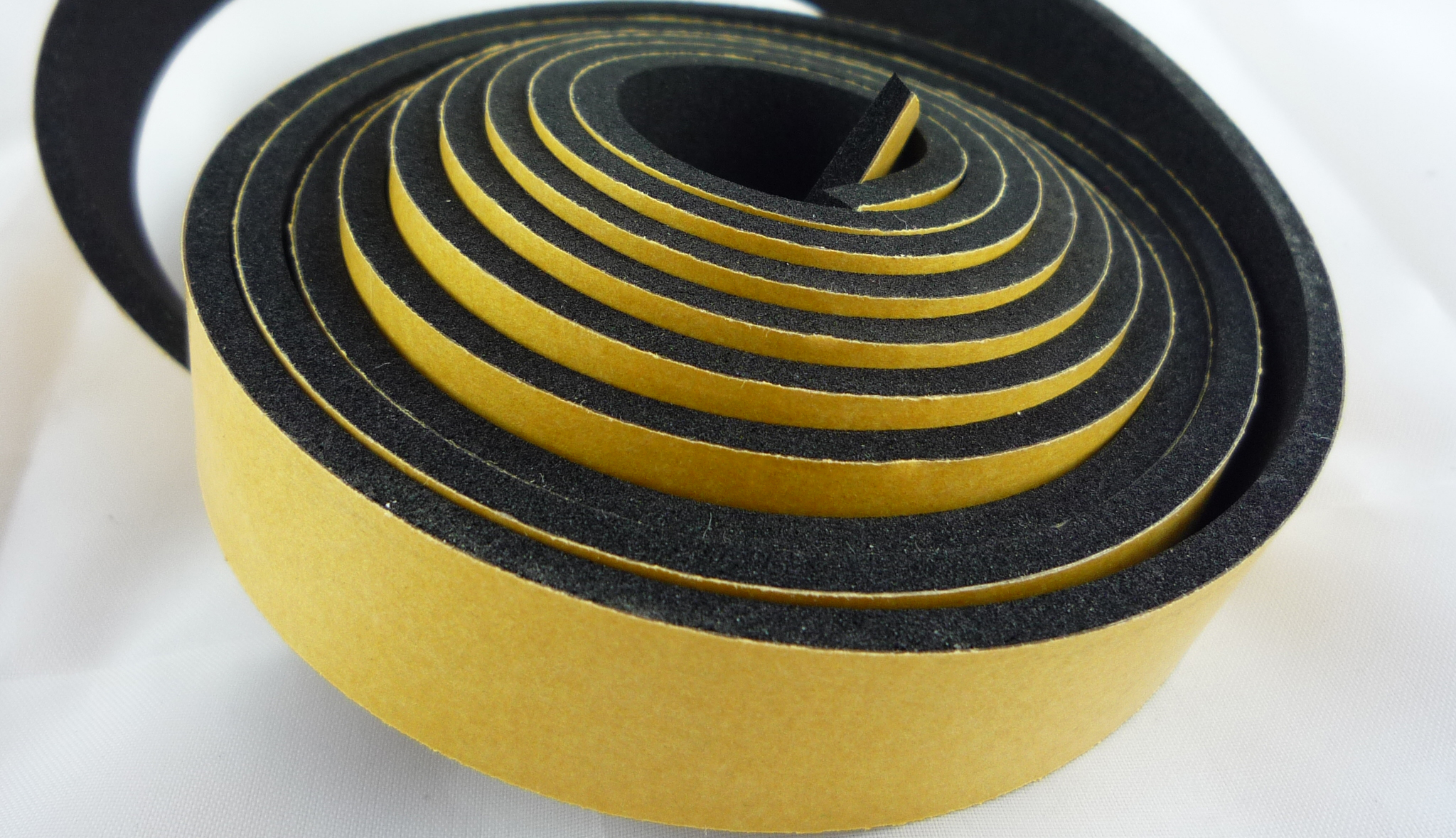
Closed Cell Sponge Applications and Products
At Hebei Shida Seal Group we make a wide range of products from closed cell sponge which service a diverse range of applications and uses. These include parts for automotive vehicle applications and general industrial use. Examples of products and parts that we have produced from closed cell sponge include: isolators, dual extrusions and weather stripping.
Closed cell sponge is an appropriate material to consider for any of the following types of applications:
- Thermal insulation
- Seals and gaskets which protect against the intrusion of moisture, UV light, or dirt
- Joint fillers and edge extrusions
- Packaging
Types of closed cell sponge material which we stock includes the following:
- Closed cell neoprene sponge rubber
- Closed cell EPDM sponge rubber
- Closed cell PVC/NBR sponge rubber
- Closed cell urethane sponge rubber
- Closed cell silicone sponge rubber
For further information on any of our closed cell sponge rubber products we can manufacture, contact our sales department at [email protected].
Rubber Molded Parts
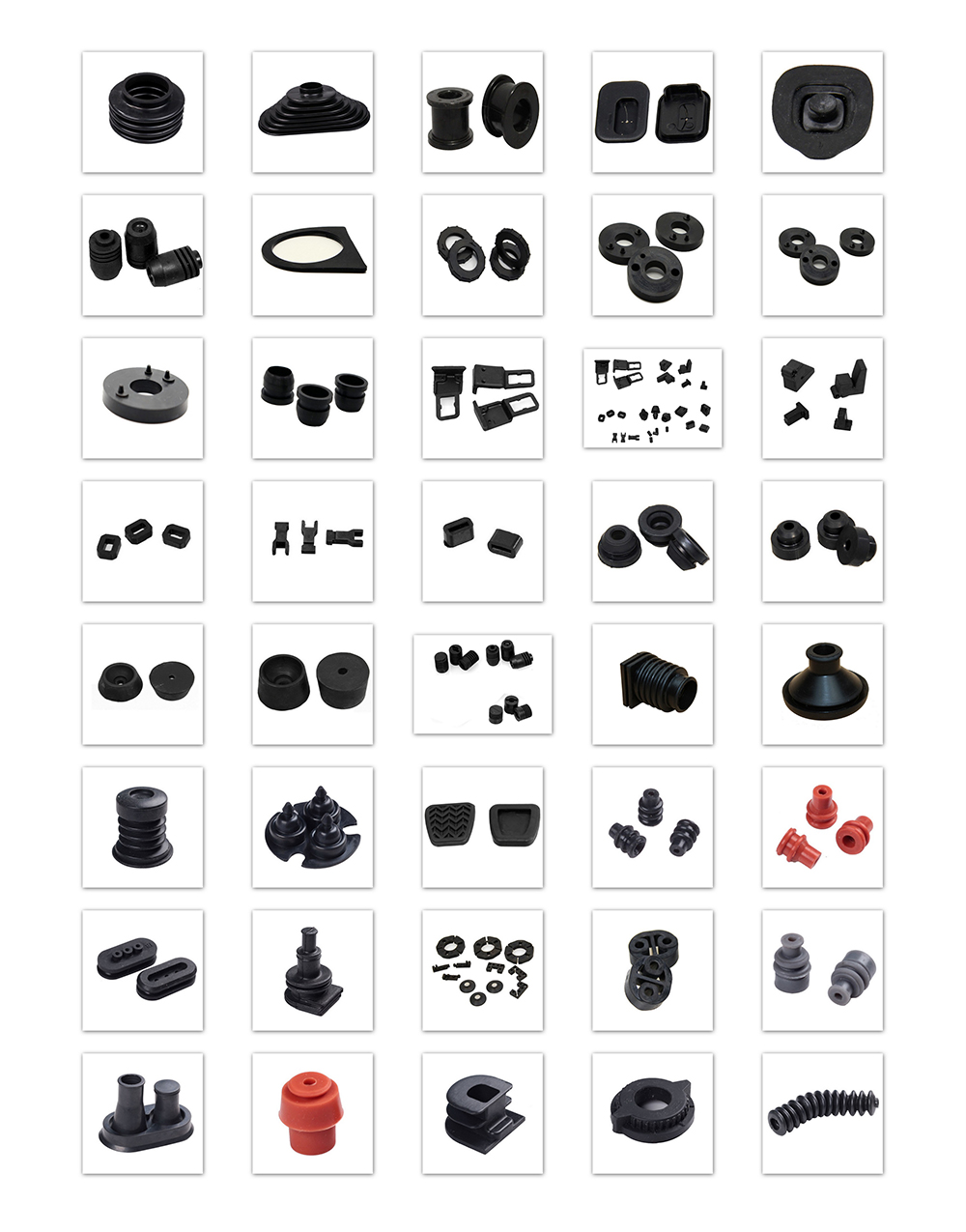
Rubber bellow for hatchback
Rubber cylinder
micro rubber gaiter
Turn-up Bladder for tyre production
Breathing mask
Silicon grommet for auxillary heating
Knob sleeves for carpentry machines
Seals for gear housing
Seals for electronic components
Oil pressure line for motor saws
seals for labelling systems
Grommet
End wall seal for air conditioning
Control device sealing
Seals for printing machines
Slanted grommet for wiring harnesses
Protective housing for measurement device
Closing caps
sealing control value
sensor sealing
Grommet for engine test bench
Rubber bellow for mirror setting
Flat gasket
Grommet for the wiring harnesses
Spray nozzle for sanitary technology
Membrane for medical technology
frame sealing
Hole disc for cleaning machines
Grommet for the electronics industry
block sealing
control sealing
Rubber bellow for blinker lever
Grommet for the wiring harnesses
Covers for dental medicine
Rubber bellow for air conditioning
grommet with diaphragm
Falling protection for crane control
Protective shell for measurement device
Fuel hose for motor saws
Housing seal for plug
hearing aid gasket
Truck-dust discharging value
gasket for auxiliary heating
Damper ring for riddle screens
Silicon protective shell for foodstuff industry
Dust discharging value
Protecting housing for control device
Rubber bellow for car electronics
oval piston seal
Distance piece for dental medicine
Oil suction line for motor saws
Double diaphragm sealing
Rubber buffer for bodywork
Instrument plating for dental medicine
Rubber bellow for electronic technology
Sealed housing for motor vehicle lighting
Protective shell for hand lamp
Rubber bellow for filter technology
Protective housing for electronic measurement device
Auxiliary heating gasket
Suction hose for motor saws
Air chamber as Lordosis support
conpensation sealing
Silicon moulded parts, lids, breathing masks, seals, sealing rings, sealing washers, rubber bellows, moulded hoses, rubber profiles, rubber buffers, catheters, fuel hoses, paste rolls, sleeves, membranes, protective housing, protective caps, silicon membranes, silicon suction cups, special seals, mirror caps, plugs, grommets and closing caps.
Ethylene Acrylate Rubber (AEM, Vamac® )
Ethylene/Acrylic elastomer (AEM, Vamac®)
Ethylene/ acrylic elastomer is a copolymer of ethylene and methyl acrylate plus a small amount of a curesite monomer containing carboxylic acid groups. AEM is a tough, low-compression-set rubber with excellent resistance to high temperatures, hot mineral oil, fluids and weathering. The low temperature flexibility and mechanic properties are better than ACM, but it is not well resistant to low aniline oil (like ASTM No. 3 oil) and polar solvents. AEM is typically chosen for applications requiring improved performance versus Nitrile rubber, Neoprene or reduced cost versus higher-end elastomers such as HNBR, FKM. It also usually is applied in automotive industry.
General Information
ASTM D 1418 Designation: AEM
ISO/DIN 1629 Designation: AEM
ASTM D2000 / SAE J 200 Codes: EE
Standard Color(s): Black
Hardness Range: 40 to 85 Shore A
Relative Cost: Medium- High
Cure system – Amine-Cured
Standard AEM compounds are Amine based vulcanization system.
Characteristics
- Excellent weather & ozone resistance
- Very good heat resistance
- Low compression set
- Resistant to most oils, greases (even with aggressive additives)
- Good low temperature properties
Service Temperatures
Standard Low Temperature: -30°C / -22°F
Standard High Temperature: 150°C / 300°F
Applications
Typical applications for AEM are all kind of static seals, hoses, gaskets in contact with oil as it happens in gear boxes, oil pumps, cam covers or others.
Vamac® is a registered trademark of DuPont Performance Polymers.
Polyurethane
POLYURETHANE (PU)
(Urethane – Polyurethane – Thermoplastic & Thermoset)
Polyurethane is a unique material that offers the elasticity of rubber combined with the toughness and durability of metal. Because urethane is available in a very broad hardness range (eraser-soft to bowling-ball-hard), it allows the engineer to replace rubber, plastic and metal with the ultimate in abrasion resistance and physical cost. Many applications using this ultra-tough material have cut down-time, maintenance time and cost of parts to a fraction of the previous figures.
Urethanes have better abrasion and tear resistance than rubbers, while offering higher load bearing capacity. Compared to plastics, Urethanes offer superior impact resistance, while offering excellent wear properties and elastic memory.
Urethanes have replaced metals in sleeve bearings, wear plates, sprockets, rollers and various other parts, with benefits such as weight reduction, noise abatement and wear improvements being realized.
Applications:
- Belts
- Metal forming pads
- Wear strips
- Bumpers
- Gears
- Bellows
- Machinery mounts
- Cutting Surfaces
- Sound-dampening pads
- Chute and hopper liners
- Prototype machined parts
- Gaskets
- Seals
- Rollers
- Roller covers
- Sandblast curtains
- Diaphragms
Hutchinson launches seventh components plant in Poland
PARIS—French-owned automotive parts maker Hutchinson is set to launch full production at its seventh plant in Poland by the end of this year.
The group’s latest facility, constructed at Zawada, near Debica in south western Poland, will produce Hutchinson’s car body seal systems for customers including the PSA Group and Volvo Cars.
This 226,000-sq.-ft. production and warehouse unit, constructed in just six months, is at the heart of the firm’s newest expansion project worth about $44 million.
Inauguration of the facility on July 19 was symbolic as it was not immediately operating, though component-assembly was expected to begin within days, Piotr Gaska head of Hutchinson’s European body sealing system division said at the ceremony.
Gaska stressed that the unit was intended to ease production pressure on the company’s existing Polish sealing systems and transmission belts plant at Lodz.
The Zawada plant will be equipped with three extrusion lines by the year-end and is set to employ an initial workforce of 240 by then. The employee total eventually will increase to 700, according to the company, part of the Total energy group.
Hutchinson Poland’s original plant was a 151,000-sq.-ft. unit making fluid transmission fuel lines, established in the south central town of Zywiec in 1997. A second plant to produce water pipes for vehicle cooling liquids and ventilation and heating systems opened there in 2000.
The first Lodz facility was launched with an area of almost 193,750 sqaure feet in 2003, while Hutchinson went on to add a second unit of 215,000 square feet there in 2007 making precision and aerial seals and antivibration systems.
A fifth production unit appeared at Bielsko-Bialain 2005 serving the automotive air conditioning and power steering systems segment. Hutchinson built its sixth unit in the country at Zywiec last year to turn out rubber compound used by the other plants.
During the recent launch, Hutchinson group CEO Jacques Maigne pointed out that Poland is the group’s “number one” location in terms of production and employment. “In 2018, we plan to exceed the level of employment to over 10,000 employees in Poland,” he said.
Last year, the group, which has an international workforce of 45,000 in 25 countries around the world, reported annual sales of more than $4.7 billion.
Physical Properties of Rubber – Second Part
Second Part covers Tear Resistance, Ozone Resistance, Low Temperature Resistance.
Tear Resistance
The tearing of rubber is a mechanical rupture process started where forces are concentrated in an area usually caused by a cut, defect or deformation.
How to Test Tear Resistance
Tear resistance is tested on a tensometer in the same manner as the tensile strength test except the specimen is one of 5 specific shapes: Type A, B, C, T or CP. A graph is produced in the same manner as the stress-strain curve except the Tear Strength graph is force over jaw separation length. Tear strength is calculated by taking the maximum force divided by the median thickness of the specimen (Ts = F/d).
Type A – Crescent shaped specimen with a nick or cut
Type B – Tab End specimen with a nick or cut
Type C – Right Angle specimen with a nick or cut
Type T (Trouser)– Molded block, 150 X 15 X 2mm, with a 40mm cut
Type CP (Constrained path)– Molded specimen 125 X 28.5 X 5.33mm. This is a special molded shape with fabric reinforcement molded in the mid-plane of the sample. The specimen has a narrows groove down the length in the center.
Ozone Resistance
Ozone (O3), resistance is used to test the relative ability of the rubber compound to resist outdoor weathering or ozone chamber testing. Some applications like door and window trim would be subject to weathering so testing would give an estimation of how the rubber compound will react to weathering. Other sources of ozone exposure include air purifiers and ozone generators used to purify, deodorize, disinfect and kill bacteria in just about everything from air to food.
How to Test Weathering/Ozone Resistance
ASTM Method D1171 addresses how to test weathering and ozone resistance. In D1171, rectangular cross section samples are wrapped around a wooden mandrel and left in the sun or placed in an ozone chamber. After a period of time either method A or method B is used to grade the samples. In method A no cracking is permitted under 2X magnification and in method B, three samples are checked and graded depending on the severity of cracking and given a quality retention value (expressed as a percentage) derived from Table 1 in ASTM D1171.
ASTM Method D1149 is used to test the effects of specific levels of ozone concentration on specimens that are under dynamic or static surface strain conditions.
Low Temperature Resistance
There are two low temperature tests that are used in testing low temperature properties of elastomers, ASTM D2137, Low Temperature Brittleness, and ASTM D1379, TR-10/TR-70 Temperature Retraction test. Low Temperature Brittleness is the most common low temperature test you will see on a physical properties data sheet. The temperature retraction test is not as common but will give you more accurate continuous operating low temperature results and a better indication of the viscoelastic and crystallization effects at low temperature.
ASTM D2137 – Low Temperature Brittleness
The Low Temperature Brittleness test is use to determine the lowest temperature at which a rubber specimen will not exhibit fractures or cracks when subject to a specific impact condition. There are two tests methods, A and B. Test Method A is for rubber volcanizates and Test Method B is for rubber coated fabrics. This test is useful for development purposes but may not necessarily indicate the lowest temperature at which the compound will operate. The TR-10/TR-70 Temperature Retraction Test is more effective in determining the lowest temperature at which a compound will continue to operate.
How to Test Low Temperature Brittleness
Specimens are cut from a die and placed into a fixture. The specimens are immersed into a liquid bath at the specified test temperature for a determined length of time. After immersion deliver a single impact to the specimen and note any cracks, fissures or holes visible to the naked eye. Repeat the test at the next highest temperature (usually 10°C increments) until the specimen passes with no cracks, fissures or holes.
ASTM D1379 – TR-10/TR-70 Temperature Retraction
The TR-10/TR-70 Temperature Retraction test is used to evaluate the crystallization effects and viscoelastic properties of the rubber specimen at low temperature. This test will give you a better indication of compounds lowest temperature at which it will continuously operate.
How to Test TR-10/TR-70 Temperature Retraction
This test is performed by stretching a die cut specimen in a special fixture to 250% elongation or 50% of the ultimate elongation if 250% can not be obtained. The stretched specimens are immersed in in a liquid at -70°C for 10 minutes freezing the sample to a state of reduced elasticity. Now, after releasing the specimens, slowly raise the temperature of the samples and measure the temperature and length of the specimens at 2 minute intervals. Report the temperature at which the sample retracted 10% (TR10), 30% (TR30), 50% (TR50) and 70% (TR70).
The TR10 value can be used to indicate the low temperature at which it will continuously operate, and it also correlates with the brittle point. The greater the temperature difference between the TR10 and TR70 the greater the tendency of the rubber to crystallize. TR70 also correlates with low-temperature compression set.
Understanding the physical properties of rubber will help you determine what properties are important to your application.