
by admin admin No Comments

Henniges Automotive Acquired by AVIC Automotive Systems Holding Co., Ltd.

Henniges Automotive Holdings, Inc., a leading supplier of a line of highly engineered vehicle sealing systems for doors, windows, trunks, lift gates, sunroofs and hoods using both rubber and plastics and anti-vibration systems for the global automotive market, announced it has been acquired by AVIC Automotive Systems Holding Co., Ltd. (AVIC Auto), a wholly-owned subsidiary of Aviation Industry Corporation of China (“AVIC”), which is also the professional platform for the development of automotive parts for the AVIC group. AVIC is a global Fortune 500 company (ranked 178 in 2014) and one of the largest state-owned enterprises in China, with its core business in the aviation industry.

As a progressively growing global supplier, Henniges Automotive designs, manufactures and sells dynamic sealing and anti-vibration solutions that keep vehicles quiet and dry for automotive original equipment manufacturers (OEMs) worldwide. Henniges recently has taken on various strategic growth moves to support customer programs in emerging markets around the world, and is in the process of expanding its global footprint with the addition of new facilities located in Mexico, China and Germany.

Douglas DelGrosso, president and CEO of Henniges Automotive, said: “We are encouraged about this acquisition by AVIC Auto, which will provide the capital and financial backing needed to sustain and grow our business, and ensure that the Henniges heritage, culture and name continue to thrive into the future. We are confident that AVIC Auto ownership will give Henniges Automotive further opportunities for continuous advancement in technology and solutions that drive positive results for our customers.”

This is one of the largest acquisitions by a Chinese company of a U.S.-based automotive manufacturing company in history; AVIC Auto also purchased Michigan-based Nexteer Automotive Group Ltd. in 2011. Henniges Automotive will benefit from AVIC Auto’s reputation as a technology and innovation leader, as well as its best-in-class solutions that result in value for customers. Additionally, as customers continue to turn to resources across the globe, this new acquisition will enhance Henniges Automotive’s worldwide capabilities and expand the Chinese market.

“This acquisition represents a long-term, strategic investment by AVIC Auto to sustain and grow the Henniges business, while keeping the successful leadership, culture, benefits and contracts associated with the company intact,” said Daen Lu, chairman of Henniges Automotive. “We are excited about this acquisition, and look forward to the addition of their significant expertise and the benefits it will bring to both of our companies.”
by admin admin No Comments

Cooper Standard opens two facilities in China

Cooper-Standard Holdings Inc. (NYSE: CPS), the parent company of Cooper-Standard Automotive Inc. (“Cooper Standard”), yesterday unveiled two new facilities in China. The Company unveiled its second Kunshan facility, a manufacturing and test center, dedicated to fluid transfer and fuel and brake delivery systems. Later this week, the company will host an opening ceremony at its new facility in Shenyang, which will produce sealing systems.

“As Cooper Standard continues to grow in China and across the Asia Pacific region, these new facilities will further strengthen our market positions and enable us to better serve our customers,” said Jeffrey Edwards, chairman and CEO, Cooper Standard. “The further localization and expansion of our test capabilities is part of our long-term commitment to the Chinese Market and is also essential to our profitable growth strategy.”

The plant openings are the latest additions to Cooper Standard’s strategic growth in China through acquisitions, joint venture partnerships and organic growth in recent years.

Expanding the fluid transfer and fuel and brake delivery systems operation to its second Kunshan location, a growing satellite city of Shanghai, reinforces the Company’s ability to serve the area where there is a concentration of automotive customers. This expansion further builds on the Company’s commitment to the region following the opening of its Asia Pacific Technical Center in Shanghai last year to provide full support to customers.

The Shenyang sealing facility, based in the industrial heartland of Northeast China, further solidifies the Company’s leading position as the largest sealing manufacturer in the Chinese market. Earlier this year, Cooper Standard acquired majority ownership of its joint venture with Chinese domestic supplier, Huayu Automotive Systems Co. Ltd.

The Kunshan and Shenyang locations cover 25,060 square meters and 8,721 square meters respectively, producing innovative products utilizing the Cooper Standard Operating System, providing consistent manufacturing processes globally. Not only will the new facilities improve volume and product mix for Cooper Standard, but they are also expected to add over 500 employees to its skilled Chinese workforce, including 20 engineers to fully support the development of global platforms designed in Asia.

Cooper Standard has steadily built up local capacity since entering the Chinese market in 2003. With these two new facilities, the Company operates 11 manufacturing and technical facilities with 5,200 employees in the country, all adjacent to major OEM operations.

About Cooper Standard
Cooper Standard, headquartered in Novi, Mich., is a leading global supplier of systems and components for the automotive industry. Products include sealing, fuel and brake delivery, fluid transfer and anti-vibration systems. Cooper Standard employs more than 27,000 people globally and operates in 20 countries around the world. For more information, please visit www.cooperstandard.com.

by admin admin No Comments

About the ISO/TS 16949:2009

What is ISO/TS 16949?

ISO/TS 16949 was jointly developed by The International Automotive Task Force (IATF) members and submitted to the International Organization for Standardization (ISO) for approval and publication. The document is a common automotive quality system requirement based on ISO 9001, and customer specific requirements from the automotive sector. ISO/TS 16949 emphasizes the development of a process oriented quality management system that provides for:

  • continual improvement
  • defect prevention
  • reduction of variation and waste in the supply chain

The goal is to meet customer requirements efficiently and effectively.

Some Benefits of Certification:

  • Customer satisfaction. Deliver products that consistently meet customer requirements.
  • Reduced operating costs. Continual improvement of processes and resulting operational efficiencies mean money saved.
  • Improved stakeholder relationships. Improve the perception of your organisation with staff, customers and suppliers.
  • Proven business credentials. Independent verification against a globally recognized industry standard speaks volumes.
  • Ability to win more business. Procurement specifications often require certification as a condition to supply, so certification opens doors.
  • International recognition. Additional confidence for global sourcing.
  • Consistent quality approach. Common approach in the supply chain for supplier or subcontractor development.

About us:

Quality Management System of Hebei Shida Seal Group is certified by NQA and applicable to the design and manufacturing of rubber weatherstrips and molded rubber products for the automotive industry.

Current Certificate: 19 June, 2015
Certificate Expiry: 18 June, 2018

by admin admin No Comments

ExxonMobil offers new route to EPDM seal compounds

ExxonMobil Chemical has developed what it says is a novel approach for formulating its Vistalon EPDM compounds for automotive sponge weatherseals.The technology is said to produce a compound that can help to reduce the density of the sponge profile, while optimizing key properties such as long term ozone resistance and sealing.

The compound combines an amorphous, high-diene EPDM rubber with a propylene-based elastomer, called Exxon IT0316, ExxonMobil said in a June 29 release.“Using this new approach to tailor EPDM rubber compounds allows customers to reduce part cost while broadening their range of sponge profiles with differentiated properties,” said Thierry Hombert, global market development manager, specialty elastomers and butyl business at ExxonMobil Chemical.

The new formulation, based on metallocene polymerisation technology is said to enable developers to tailor properties through the precise control of the molecular architecture and co-monomer introduction.Tests on a semi-industrial ultra high-frequency extrusion line show that blowing-agent efficiency is optimised without compromising the sealing properties of the sponge profile, according to ExxonMobil.

“Compression load deflection and compression set are maintained, and density can be reduced by 10 percent, which provides the potential to reduce costs,” the firm said said. “The uncured, soft-sponge compound also exhibits more green strength, improving weatherseal handling.“Compounders can tailor the performance of the sponge weatherseal to produce a profile that has a similar density to an EPDM compound but with a higher CLD or a profile with a lower density but a similar CLD.”

Source: Rubber & Plastic News

by admin admin No Comments

Properties of Rubber Extrusions / Seals Tested

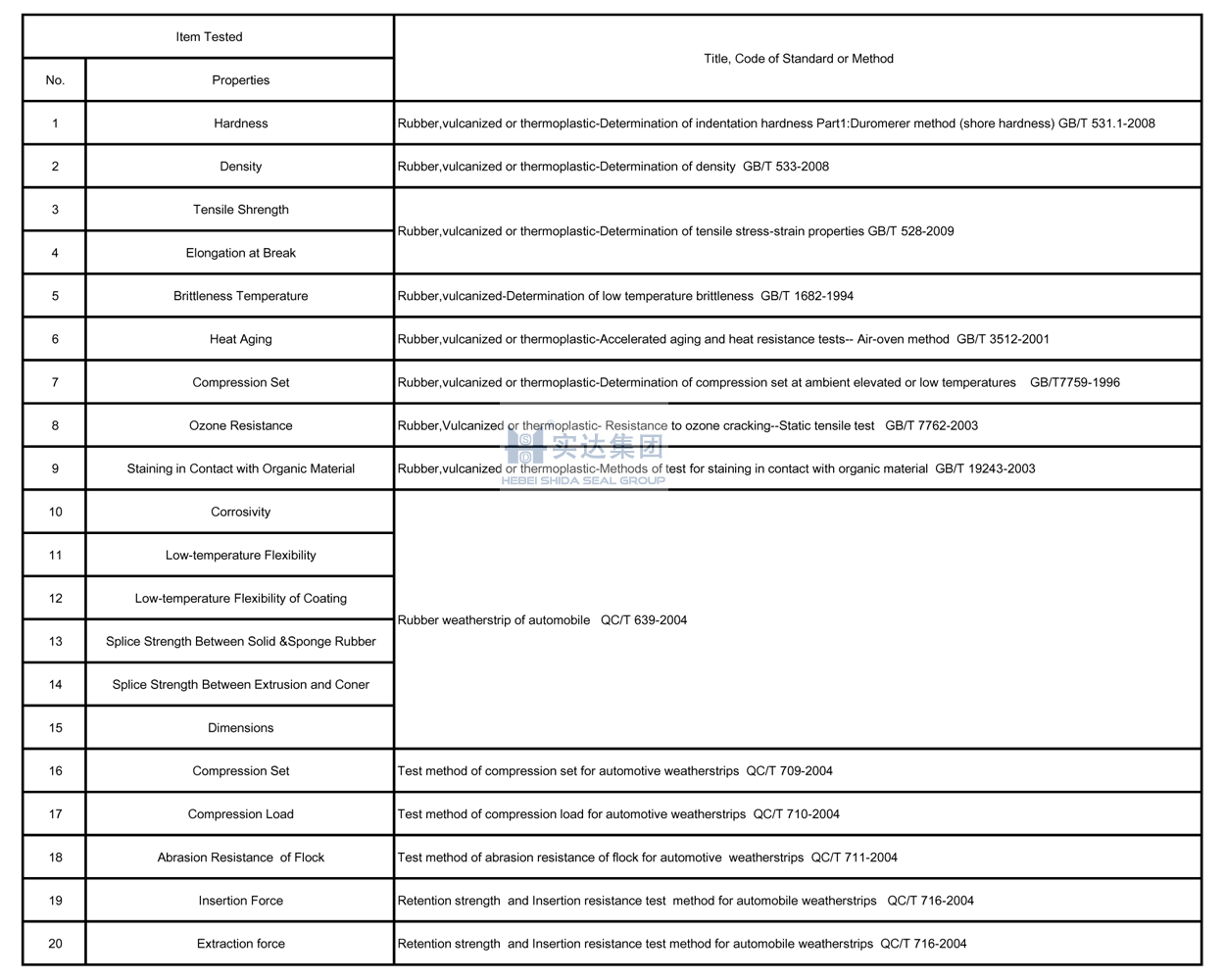
We test all materials and products to industrial, national standards and customer-specific requirements in-house or with third-parties. For example, we can test these properties of rubber extrusions / seals: hardness, density, tensile strength, elongation, brittleness temperature, heat aging, compression set, ozone resistance, staining in contact with organic material, corrosivity, low-temperature flexibility, low-temperature flexibility of coating, splice strength between solid &sponge, splice strength between extrusion and corner, dimensions, compression load, abrasion resistance of flock, insertion force, extraction force.

rubber seals test

by admin admin No Comments

Rubber extrusions meet specifications of national standards in China

Hebei Shida Seal Group extrudes a variety of rubber and plastics and produces weather-strips and seals for a number of different industries
including automotive, railway, etc. Our rubber extrusions meet and exceed specifications of national standards in China. At the same time, our rubber products can also meet ASTM, SAE specifications depending the particular application and part.

 Standard Number: QC/T 639-2004
 Standard Title: Rubber weatherstrips for automobile
 Scope: The standard stipulates specification for rubber weatherstrips for automotive applications, test methods, and specification for inspection, marking, packaging, shipping and storage of these rubber products. The standard is applicable to all types of rubber weatherstrips for automotive applications made of EPDM (Ethylene Propylene Diene Terpolymer).
   
 Standard Number: GB/T 21282–2007
 Standard Title: Rubber/plastics weatherstrip for automobile
 Scope: The standard stipulates specification for rubber/plastics weatherstrips for passenger cars, test methods, and specification for inspection, marking, packaging, shipping and storage of these rubber/plastics products. The standard is applicable to all types of rubber weatherstrips for passenger cars made of rubber, plastic, alone or in combination.
   
 Standard Number: GB/T 27568-2011
 Standard Title: Rubber gasket for doors & windows in railway vehicles
 Scope: The standard stipulates specification for rubber gasket for doors & windows in railway vehicles, test methods, and specification for inspection, marking, packaging, shipping and storage of these rubber products. The standard is applicable to rubber gasket for doors & windows of all sorts of vehicles that run on the rails including subways, light rail vehicles, high speed trains, etc.


by admin admin No Comments

Cooper Standard Becomes Largest Chinese Automotive Sealing Manufacturer

Cooper-Standard Holdings Inc. the parent company of Cooper-Standard Automotive Inc. (“Cooper Standard”), announced the completion of its purchase of Huayu Automotive System Co.’s share in Huayu-Cooper Standard Sealing Systems Co., Ltd. on February 27, 2015. Cooper Standard is now 95 percent equity owner of the business. As a result of the transaction, Cooper Standard is now the largest automotive sealing manufacturer in the domestic Chinese market with nine manufacturing facilities and two technical centers, including its recently opened Asia Pacific Technical Center and headquarters in Shanghai.

About Cooper Standard
Cooper Standard, headquartered in Novi, Mich., is a leading global supplier of systems and components for the automotive industry. Products include sealing, fuel and brake delivery, fluid transfer and anti-vibration systems. Cooper Standard employs more than 27,000 people globally and operates in 20 countries around the world.

by admin admin No Comments

Types of Auto Weatherstrips – 2

According the characteristics, rubber weatherstrips for cars, trucks, and RV’s can be classified into two groups: dynamic seals and static seals.

1. Dynamic seals exist where there is relative motion between the mating surfaces being sealed. Typical dynamic seals include primary door seals(mounted on door), secondary door seal(mounted on body),hood/deck lid seals, trunk/tailgate seals, sunroof rubber seals, rocker seals.

dynamicseals

2. Static seals exist where there is no relative motion between the mating surfaces being sealed.Typical static seals include front and rear windshield weatherstrips, quarter window seals, window glass run channels, inner and outer belts & weatherstrips, etc.

About Us:
Hebei Shida Seal Group is located in Qinghe, Hebei, China, and is a Tier I supplier of dynamic and static rubber sealing weather-stripping to the automotive industry, and has attained TS 16949 designation. Main products are automotive body mounted sealing profiles & weatherstrips: EPDM rubber extrusion, sponge (cellular) rubber extrusion, flocked glass run channel, metal embedded and wire carries embedded rubber extrusion using latest curing system (microwave curing) .

by admin admin No Comments

Rubber Molding Processes

Rubber Molding Processes

Processing rubber to produce final products for end use really depends on what the shape and product is. The main processes for shaping rubber are Extrusion, Compression Molding, Transfer Molding, and Injection Molding.

1. Rubber Extrusion

Extrusion is a continuous manufacturing process in which rubber is squeezed through a die and then vulcanized (industry terminology for cured). The die gives the extrudate its shape. The required pressure is produced via a conveying screw, in which the material is mixed, compressed and extruded through the die form to produce the final shape.

Extrusion Process Steps

  • The extrusion process begins with the unvulcanized (uncured) rubber compound being fed into the extruder.
  • Next, the flutes of the revolving screw will carry the rubber forward into the die, with an increase in pressure and temperature occurring as the material gets closer to the die itself.
  • Once it reaches the die, the built up pressure forces the material through the openings, where it will consequently swell in various degrees based on the material compound and hardness.
  • Because rubber has this tendency to swelling, many extruded parts require compensation on the cross sections of the die.
  • During the vulcanization (curing period), the extruded rubber will swell or shrink in both its cross section and its length depending on the type of rubber compound used.

2. Rubber Compression Molding

Compression molding is a process that involves taking a rubber compound or mixed raw material and creating “preforms” in the basic shape of the end product. The preforms provide a surplus of material to be placed in the cavity, thus ensuring a total cavity fill. Once in place, the mold is then closed, applying both heat and pressure to the preform and allowing it to fill the cavity. When the cavity is filled, excess preform material spills out into overflow grooves. Following this step the rubber is then demolded, usually by hand, leaving us with the molded rubber product.

Compression Molding Process Steps

  • Uncured rubber is preformed into a control weight, shape and specification.
  • Rubber preform is then placed into the mold cavity.
  • Rubber mold is then closed compressing the rubber to fill the molds cavities.
  • The mold remains closed under pressure and held at a temperature to allow the rubber to reach optimal cure.
  • Compressed rubber parts are then removed from the mold and the process is ready to begin again.

3. Rubber Injection Molding

Injection molding of rubber is based upon a process intended for the molding of plastics. Rubber injection molding successfully alters the plastics process by heating the rubber and placing it under significantly more pressure per square inch of cavity surface in molding. This is different from the plastic injection molding process where the materials are cooled under less pressure. Through various innovations, injection molding has become one of the most efficient ways to create molded rubber products in many cases particularly with more complex shapes.

The operation of an injection molding machine requires: feeding, mixing, and injection of a measured volume of compound, at a temperature close to the vulcanization temperature, into a closed and heated mold; a curing period; demolding; and, if necessary, mold cleaning and/or metal insertion (Overmolding process), before the cycle starts again. For maximum efficiency, as many of these elements as possible should be automated.

Injection Molding Process Steps

  • The uncured rubber is fed into the machine in the form of a continuous strip.
  • The uncured rubber is worked and warmed by the rotation of the screw in a temperature controlled barrel.
  • As the rubber stock accumulates in the front of the screw, the screw is forced backwards. When the screw has moved back to a specific point, this indicates the correct amount of rubber (shot amount) is ready for injection.
  • With the mold held closed under hydraulic pressure, the screw is pushed forward. This forces the rubber into the mold (this is the injection process).
  • While the rubber cures (vulcanizes) in the heated mold, the screw starts rotating and filling with the new rubber (the next shot).
  • The mold then opens and the part can be removed. The machine is ready to make the next shot as soon as the mold closes again.

About Us:
Hebei Shida Seal Group is located in Qinghe, Hebei, China, and is a Tier I supplier of molded rubber products to the automotive industry, and has attained TS 16949 designation. Main molded rubber products are rubber grommets, wire harness rubber parts, air intake hoses, rubber boots, rubber seals, rubber components, rubber diaphragms, rubber bumpers and stoppers using latest molding technology.

by admin admin No Comments

Standard Profil opens new plant in Mexico

Europe’s second biggest sealing provider Standard Profil opened its globally 10th plant in Mexico. The Guanajuato plant will produce automotive sealing systems for North American automotive giants.

Automotive sealing manufacturing company Standard Profil expands its global operations to America. Its 10th plant, opened on 12th January, 2015 in Guanajuato-Mexico, will provide sealing systems to North American automotive giants. The plant which has been built from ground zero in 9 months with an investment of 36 million USD is a cutting edge facility equipped with Standard Profil’s best technologies.

Standard Profil CEO Turhan Semizer stated that this plant will have an important role in Standard Profil’s globalization strategy and said: “38 years ago, Standard Profil has started its journey in Turkey, and now it is Europe’s second biggest sealing provider with about more then 20% of the market share. We always aim to be closer to our customers and that’s why we are here, very close to the Automotive Global OEMs. We want to continue our success in North America as well. We believe in our new plant and colleagues in Mexico who will bring us to the goals we set for our common future. Our success will continue to grow as we move forward together as the Standard Profil family.”

Mexico is one of the leading players in North America by supplying automotive giants in its land and as a result withholding a great experience in the Automotive Industry. Standard Profil aims to turn these attributes to an advantage by transferring its technological skills and product quality gained until today, from this point in Mexico to the whole American automotive industry. With the strength and advantages provided by this production site, Standard Profil will be in a much more competitive position in North America.


source: Standard Profil website